

TL;DR — THE SHORT ANSWER
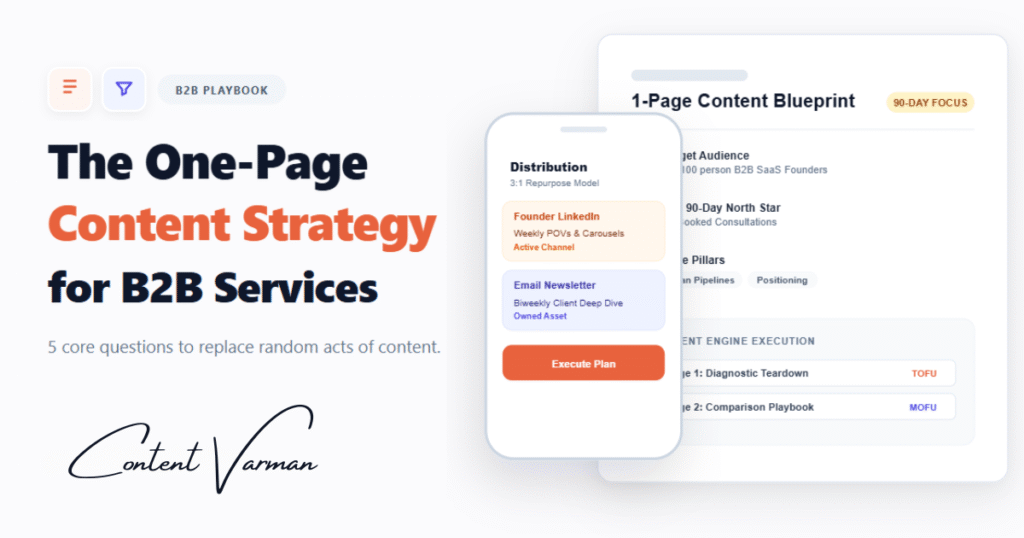
Most B2B service businesses don’t have a content strategy — they have a content habit. Fix it with one page that answers five questions: who it’s for, what number it needs to move, which 3–5 topics you own, what buyers need at each stage, and where it gets distributed. If it doesn’t fit on one page, it’s too complicated to actually use.
Sit through enough content planning meetings and you start noticing the same pattern. A case study goes up when a happy client agrees to it. A LinkedIn post happens when someone remembers. A blog post gets written the week before a slow quarter, out of guilt more than strategy.
None of that compounds. None of it ties back to revenue. And eventually it gets abandoned because it feels like unpaid extra work instead of a business asset.
The fix isn’t a 40-page plan nobody will reread. It’s one page — something you could pin above your desk — that answers five questions and then acts as a filter for every idea that comes after.
Five questions, one page
If your answers spill onto a second page, that’s usually a sign you’re overcomplicating it, not being thorough.
1. Who exactly is this for?
Write one sentence:
“This content is mainly for [a specific role] at [a specific type of company], who are trying to [a specific outcome they care about].”
For example:
- “This content is mainly for founders running 10–100 person B2B SaaS teams, who are trying to build a predictable sales pipeline without hiring a full marketing department.”
- “This content is mainly for CFOs at mid-sized manufacturing companies, who are trying to free up cash tied up in inventory.”
A useful test: if the sentence still works after you delete “at [type of company],” it’s too broad. The moment you type “any business that needs X” or “everyone in [industry],” stop and narrow it. Content built for everyone resonates with no one — and it’s also harder for a search engine or an AI assistant to associate your content with a clear audience.
2. What single number does this content need to move?
Not five goals. One outcome, over the next 90 days.
Realistic options for a service business:
- Booked discovery calls or demo requests
- Inbound leads from one specific segment
- Newsletter subscribers who match your ideal client profile
- Reply rates on outbound emails, boosted by content prospects have already seen
- Strong applicants, if the content is aimed at hiring
Frame it as:
“Over the next 90 days, this content needs to drive [the metric], by moving readers toward [one specific next action].”
Example: “Over the next 90 days, this content needs to drive 20 booked strategy calls, by moving readers toward requesting a 30-minute consultation.”
Every piece you publish should be able to answer: does this move that number? If it can’t, you’ve written a vanity topic — something that feels good to publish but does nothing for the business.
3. Which 3 to 5 topics will you own?
You’re not a news outlet. You need a short list of themes you return to again and again, each capable of producing ten-plus pieces over time.
“We’re going to own:
1. [Topic A]
2. [Topic B]
3. [Topic C]”
For a growth consultancy serving small SaaS teams:
- Building sales pipelines for lean B2B SaaS teams
- Sharpening positioning for niche software products
- Running marketing operations without a big team
For a fractional finance firm:
- Managing cash flow in manufacturing businesses
- Improving pricing and margins for service companies
- Telling a compelling financial story to investors
Test every topic: does this connect directly to what we sell, or to a stage in how buyers decide? If not, drop it — no matter how “on brand” it feels.
4. What does a buyer need from you at each stage?
Skip the complicated funnel diagram. Use a simple three-stage map with one or two formats attached to each stage.
| Stage | What they’re figuring out | What helps them | Good formats |
|---|---|---|---|
| Realizing the problem | “Is this actually worth solving?” | Naming the problem, showing its cost | Short articles, checklists, a self-assessment quiz |
| Weighing options | “What are the different ways to fix this?” | Comparing paths, sharing a POV | In-depth guides, comparison posts, a webinar |
| Deciding who to trust | “Can this company deliver?” | Proof, reduced risk, specificity | Case studies, walkthrough videos, a “how we work” page |
For a B2B content agency, filled in:
- Realizing the problem: They’re thinking “we keep publishing and nothing’s happening.” You respond with “Why your blog isn’t producing leads” or a diagnostic checklist — as posts, carousels, or a quick teardown video.
- Weighing options: They’re asking “do we hire, outsource, or muddle through?” You respond with an in-house-vs-agency-vs-fractional comparison, a planning template, or a webinar.
- Deciding who to trust: They’re asking “will this team deliver?” You respond with three to five case studies, a process page, and short clips from real client conversations.
This map becomes your sorting mechanism — every new idea gets slotted into one of the three boxes before it’s approved.
5. Where will this content actually get seen?
Most teams overestimate early organic search traffic and underestimate the channels they already control — email, LinkedIn, and the sales conversations happening every week.
“We’ll distribute mainly through:
– [Channel 1]
– [Channel 2]
– [Channel 3]
And every core piece gets repurposed into at least [X] smaller assets.”
Example: “We’ll distribute mainly through the founder’s LinkedIn profile, a biweekly newsletter, and as leave-behinds in sales conversations. Every core piece becomes at least three smaller assets — a post, a carousel, and an email section.”
Be realistic about what you can sustain. Showing up consistently on one channel beats spreading across three and disappearing from all of them in a month.
Put together, it looks like this
Audience: Founders and heads of growth at 10–100 person B2B SaaS companies who want a repeatable pipeline without a full marketing team.
90-day outcome: 20 booked strategy calls, via readers requesting a 30-minute consultation.
Core topics: Pipeline building for lean SaaS teams · Positioning for niche software · Running marketing without a big headcount
Buyer journey: Problem-awareness posts and teardown videos → comparison guide and planning template → case studies and a “how we work” page
Distribution: Founder’s LinkedIn plus company page, a biweekly newsletter, sales leave-behinds — every core piece repurposed into a post, a carousel, and an email section.
That’s the whole strategy. One page, nothing buried in a slide deck nobody reopens.
Keeping the page useful, week after week
A strategy that sits in a drive folder is worthless. Turn it into a working filter:
- Keep a separate list for raw ideas — don’t touch the strategy page every time inspiration strikes.
- Before green-lighting anything, run it through the page: which audience, which topic, which journey stage, which channel, and how does it move the 90-day number?
- If an idea can’t get a fast answer, shelve it. Don’t force it into the calendar out of guilt.
- Once a month, revisit the page: is the audience still right, is the outcome still the priority, does a topic need adding or retiring?
Mistakes that quietly wreck this
- Naming too many audiences. More than one “and” in your audience sentence means you’re describing several audiences stitched together. Pick the primary one; build a separate page for the rest later.
- Chasing too many outcomes. “Brand awareness, leads, hiring, rankings, and partnerships” is a wish list, not a strategy. Pick the single most important outcome for this quarter.
- Writing topics that are really categories. “Marketing,” “Growth,” and “Strategy” are departments, not topics. Good topics sound like something a buyer would type into a search bar or say out loud on a call.
- Leaving distribution vague. “SEO and social media” means you haven’t decided anything. Name the exact channels and the exact repurposing rule.
Try it now — 15 minutes
- Audience sentence — 3 minutes
- 90-day outcome — 3 minutes
- Three to five core topics — 4 minutes
- Buyer journey map, one or two lines per stage — 3 minutes
- Distribution plan — 2 minutes
Don’t chase perfection on the first pass. Aim for something clear enough to act on tomorrow — you’ll sharpen it as real content goes out and real results come back.