
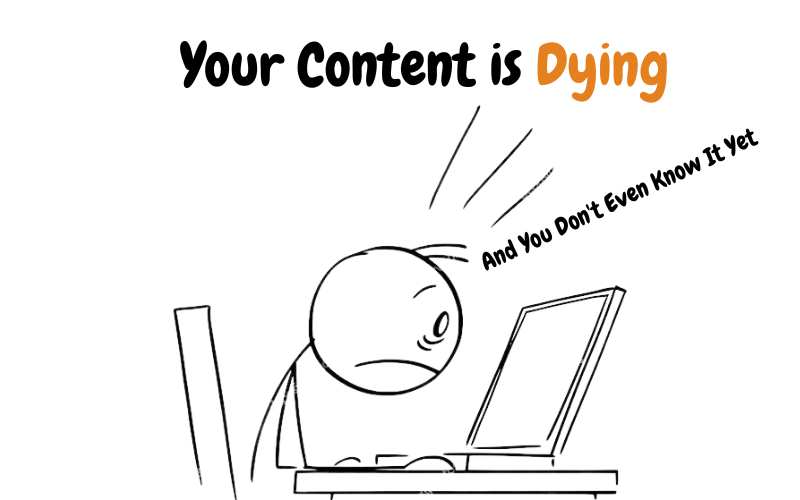
If you’ve been wondering why your content isn’t performing the way it used to, you’re asking the right question. The answer isn’t that content marketing is broken—it’s that the rules have quietly changed.
There was a time when publishing consistently was enough. If you wrote a few blogs every month, posted daily on LinkedIn, uploaded a couple of Reels, and kept your website updated, you could expect steady growth in traffic and engagement.
That isn’t the reality I’m seeing in 2026.
Over the past year, I’ve noticed something interesting across businesses of all sizes. Teams are creating more content than ever before, yet many of them are struggling to generate qualified leads, meaningful engagement, or even consistent organic visibility. The effort has increased, but the outcomes haven’t always followed.
At first glance, it might seem like content marketing is losing its effectiveness.
I don’t believe that’s true.
I believe the way people discover, evaluate, and trust content has fundamentally changed.
Today, someone might discover your brand through a Google AI Overview, read one of your LinkedIn posts, watch a short YouTube video, ask ChatGPT about your topic, and only then decide whether it’s worth visiting your website. Your blog is no longer the first interaction with your audience—it’s often one of many.
That shift changes how we should think about content.
Writing simply to rank for keywords or publishing because the calendar says it’s Tuesday isn’t enough anymore. People have endless information at their fingertips. What they’re looking for now is clarity, credibility, and confidence that the person behind the content actually knows what they’re talking about.
In this article, I want to share the biggest content marketing trends I’m seeing in 2026, the strategies that are producing real business results, and a few practices I believe are quietly becoming obsolete.
Whether you’re a marketer, founder, consultant, or business owner, these are the shifts worth paying attention to.
The Biggest Shift I’ve Seen: From Publishing More to Saying Something That Matters
For years, the advice was simple.
Publish more.
More blogs.
More LinkedIn posts.
More videos.
More everything.
I followed that advice too because, for a long time, it worked.
But today, consistency is no longer your competitive advantage. It’s the minimum expectation.
The businesses standing out aren’t necessarily producing more content than everyone else. They’re producing content that actually gives people a reason to stop scrolling.
That’s a very different goal.
I’ve realized that audiences don’t need another article listing “10 SEO Tips” or “5 Ways to Grow on LinkedIn.” AI can generate those in seconds, and readers know it.
What they can’t get from AI alone is your experience.
They want to know what you’ve learned after running campaigns, working with clients, fixing problems, or making mistakes. They want practical insights, not recycled advice.
That’s why I think the biggest shift in content marketing isn’t about producing more content.
It’s about creating content with conviction.
When you have a clear point of view, people remember you.
When you simply repeat what everyone else is saying, they move on.
Trend #1: Point-of-View Content Is Winning Attention
If there’s one trend I expect to continue growing throughout 2026, it’s this:
Opinionated, experience-driven content consistently outperforms generic educational content.
That doesn’t mean writing controversial posts just for engagement.
It means being willing to explain what you believe based on your own experience.
Instead of publishing another article called:
“5 Tips for Better SEO”
I’d rather read something like:
- Why I Think Keyword-First SEO Is No Longer Enough
- The Biggest Mistake I See in B2B Dashboard Projects
- Why Most Real Estate Ads Fail Before the Leads Even Arrive
- What I Stopped Doing in Content Marketing (And Why)
Those headlines immediately make me curious because they promise a perspective—not just information.
That’s exactly what modern audiences are looking for.
Why This Works
I’ve noticed that readers engage more deeply when they feel there’s a real person behind the article.
They don’t just want facts.
They want context.
They want stories.
They want to understand why something works and when it doesn’t.
That’s something AI can’t manufacture on its own.
For example, if you’ve managed dozens of real estate campaigns, you’ve probably seen patterns that someone writing from theory hasn’t. Maybe you’ve learned that reducing response time from ten minutes to two minutes improves site visits more than increasing the advertising budget.
That’s worth writing about.
If you’ve implemented BI platforms across different organizations, you’ve probably seen why dashboard adoption fails even when the technology is excellent.
That’s another story worth telling.
Your experience is becoming one of your strongest competitive advantages.
Use it.
Make Your Content Sound Like You
One mistake I still see businesses making is trying to sound overly professional.
Everything becomes filled with corporate language.
Everything feels polished.
Everything sounds… exactly the same.
I’ve found that the best-performing content usually sounds like a conversation I’d have with someone over coffee.
It’s clear.
It’s practical.
It isn’t trying to impress anyone.
Instead of saying:
“Organizations should leverage cross-functional collaboration to maximize digital transformation initiatives.”
I’d simply say:
“The technology usually isn’t the problem. In my experience, it’s the people and the process that slow projects down.”
Both sentences communicate a similar idea.
One sounds human.
The other sounds like it came from a corporate presentation.
Guess which one people remember.
Ask Yourself One Question Before Publishing
Before I publish any article, I ask myself one question:
Could someone else write this exact article without having my experience?
If the answer is yes, I know I haven’t gone deep enough.
That’s usually when I’ll add a client story, a lesson from a campaign, an observation I’ve made, or even a mistake I’ve learned from.
Those details don’t just make the article more interesting.
They make it more trustworthy.
And in 2026, trust is becoming one of the most valuable currencies in content marketing.
Trend #2: Discovery Happens Everywhere—Not Just on Google
One of the biggest mindset shifts I’ve made recently is realizing that people don’t discover brands the way they used to.
A few years ago, someone might search Google, click your website, read a blog, and make a decision.
Today, the journey is far less predictable.
Someone might first come across your LinkedIn post.
A week later, they watch one of your videos.
Then they see your company mentioned in an AI-generated answer.
Later, they read one of your blogs before finally reaching out.
That’s why I no longer think of content as individual pieces.
I think of it as a connected ecosystem.
Every blog, LinkedIn post, video, case study, and email contributes to building familiarity and trust.
Not every piece needs to generate a lead.
Sometimes its job is simply to make someone remember your name.
And in a crowded digital world, that’s often the first step toward earning their business.
In Part 2, I’ll share why I believe AI should support your content—not replace it, why short-form content alone won’t build authority, and why it’s time to stop measuring success with vanity metrics.
Trend #3: AI Is Changing Content Marketing—But Not in the Way Most People Think
If you’ve spent any time on LinkedIn this year, you’ve probably noticed an explosion of AI-generated content.
On paper, that sounds like a good thing. Businesses can create blogs faster, marketers can publish more frequently, and small teams can suddenly produce the amount of content that once required an entire department.
But after reading hundreds of AI-written articles, I’ve noticed a pattern.
Most of them sound the same.
The structure is predictable. The examples are generic. The advice feels safe. By the time you finish reading, you don’t remember who wrote it—or why it mattered.
That’s the biggest mistake I see marketers making in 2026.
They’re asking AI to replace their thinking instead of amplifying it.
I’ve made AI part of my own workflow, but probably not in the way many people assume. I use it to organize research, generate outlines, brainstorm angles I may not have considered, and repurpose long-form content into LinkedIn posts or email newsletters. It saves me hours every week.
What I don’t outsource is my perspective.
The lessons I’ve learned from client projects, the mistakes I’ve made, the conversations I’ve had with business owners, and the opinions I’ve developed over the years are what give my content its value. AI can help me communicate those ideas more efficiently, but it can’t create them for me.
That’s an important distinction.
The businesses that will stand out over the next few years won’t be the ones producing the most AI-generated content. They’ll be the ones combining AI’s efficiency with genuine human expertise.
My AI Content Workflow
People often ask whether AI is replacing content writers.
I don’t think that’s the right question.
The better question is:
“Which parts of the content process should AI handle, and which parts should remain human?”
Here’s the workflow I’ve found works best.
I let AI handle repetitive tasks like:
- Researching a topic from multiple angles
- Creating article outlines
- Suggesting headlines
- Finding content gaps
- Repurposing blogs into social posts
- Summarizing long documents
Once that’s done, I step in.
That’s where I add my opinions, client experiences, examples, practical recommendations, and observations from real projects. Those are the things readers actually remember.
Think of AI as your research assistant.
Not your replacement.
Trend #4: Short Videos Get Attention. Long-Form Content Builds Trust.
A question I hear quite often is:
“Are blogs still worth writing in 2026?”
My answer is always yes.
In fact, I’d argue they’re becoming even more valuable.
Short-form content is fantastic for discovery. A 30-second Reel or a quick LinkedIn video can introduce someone to your brand in seconds. It creates awareness and curiosity.
But curiosity alone rarely closes a deal.
When someone is evaluating a software platform, choosing a marketing partner, investing in a BI solution, or buying property, they’re looking for confidence—not entertainment.
That’s where long-form content becomes incredibly powerful.
A detailed blog, case study, webinar, or in-depth YouTube video gives you the space to answer questions, address objections, share experiences, and demonstrate expertise in a way that short-form content simply can’t.
I’ve started thinking about content like a movie.
The Reel is the trailer.
The blog is the full film.
Both matter, but they serve different purposes.
Build Content That Works Together
One mistake I made earlier in my career was treating every piece of content as a separate project.
Now I think differently.
Every piece should support the next.
For example, a short LinkedIn post might introduce an idea.
That post leads someone to a detailed blog.
The blog links to a case study.
The case study encourages them to book a consultation.
Instead of asking,
“How can this blog generate leads?”
I now ask,
“Where does this blog fit into the customer’s decision-making journey?”
That small mindset shift has changed how I approach content planning.
Content performs much better when every asset supports a larger story instead of trying to achieve everything on its own.
Trend #5: The Best Content Isn’t Measured by Likes
One of the healthiest changes I’m seeing in marketing is that more businesses are starting to look beyond vanity metrics.
For a long time, success was measured by numbers that looked impressive on a dashboard.
Followers.
Likes.
Comments.
Impressions.
Those metrics aren’t useless.
They tell you whether people noticed your content.
But they don’t tell you whether your content actually influenced a business outcome.
That’s a very different question.
Today, when I review content performance, I’m far more interested in metrics like:
- Did this article generate qualified enquiries?
- Did someone mention reading it during a sales call?
- Did it increase branded searches?
- Did it help someone understand a complex topic?
- Did it contribute to building trust over time?
Sometimes the article with the fewest likes turns out to be the one that generates the highest-value opportunities.
That’s why I’ve stopped judging content by how popular it looks on social media.
I judge it by what it contributes to the business.
What I Believe Is Quietly Dying in Content Marketing
Just as some strategies are becoming more effective, others are slowly losing their impact.
Here are five practices I believe marketers should leave behind.
1. Publishing Just to Stay Consistent
Consistency still matters.
But consistency without purpose simply creates more noise.
I’d rather publish one insightful article each week than seven posts that nobody remembers.
Quality compounds.
Quantity alone doesn’t.
2. Writing Only for Search Engines
I’ve read countless articles that clearly weren’t written for people.
Every paragraph feels engineered around keywords.
Every sentence sounds unnatural.
The problem is that readers notice it immediately.
The best-performing content I’ve seen always starts with a simple question:
“Will this genuinely help someone?”
When the answer is yes, search visibility usually follows.
3. Playing It Safe
One thing I’ve learned is that memorable content almost always has a point of view.
If every article sounds neutral, nobody remembers who wrote it.
That doesn’t mean being controversial for attention.
It means being willing to share your experience, challenge common assumptions, and explain why you believe something works differently.
That’s what builds authority.
4. Trying to Be Everywhere
A lot of businesses feel pressure to publish on every platform.
LinkedIn.
Instagram.
Facebook.
Threads.
YouTube.
TikTok.
Blogs.
Podcasts.
Newsletters.
The reality is that very few teams can do all of those well.
I’d rather become known on one platform before expanding to five.
Depth almost always beats breadth.
5. Celebrating Vanity Metrics
The final habit I’d leave behind is celebrating numbers without context.
A thousand likes don’t necessarily mean a thousand opportunities.
Sometimes one article read by the right decision-maker is worth more than ten viral posts.
I’ve seen businesses generate significant revenue from content that never became “popular.”
That’s a good reminder that marketing isn’t about collecting attention.
It’s about creating trust that eventually turns into business.
In the final part, I’ll share the content marketing checklist I use before publishing, along with practical actions you can apply immediately, key takeaways, and answers to the questions I hear most often from marketers and business owners.
A Practical Content Marketing Checklist for 2026
Whenever I’m planning content for a brand or reviewing an existing strategy, I don’t start by asking, “What should we post next?” Instead, I ask a much simpler question:
“Would I stop scrolling to read this?”
If the answer is no, neither will my audience.
Over the years, I’ve realized that successful content marketing isn’t about producing more assets—it’s about producing content with purpose. Before I hit publish, I run through a quick checklist to make sure every article, video, or LinkedIn post is actually helping the business, not just filling the content calendar.
Here’s the same checklist I use.
1. Does This Content Solve One Specific Problem?
One of the biggest mistakes I see is trying to answer ten questions in a single article.
Instead, I focus on solving one meaningful problem really well.
For example, rather than writing a generic article on digital marketing, I’d rather publish something like:
- Why BI dashboards fail even after implementation
- Why real estate leads don’t convert into site visits
- Why your LinkedIn content isn’t generating inbound enquiries
The more specific the problem, the more valuable the content becomes.
2. Have I Added Something Only I Can Say?
This is probably the most important question on my checklist.
Before publishing, I ask myself:
“What in this article couldn’t have been written without my experience?”
Sometimes it’s a lesson from a client project.
Sometimes it’s a mistake I made.
Sometimes it’s a framework I’ve developed after working on multiple campaigns.
Those moments make content memorable because they’re based on experience, not research alone.
If an article could have been written by anyone, it probably won’t stand out.
3. Am I Helping the Reader Make a Decision?
Good content informs.
Great content helps people decide.
After reading your article, the audience should feel more confident about their next step.
That doesn’t mean forcing a sales pitch into every blog.
It simply means reducing confusion.
The best articles leave readers thinking,
“Now I know exactly what I should do next.”
4. Is My Content Easy to Read?
People don’t read online the way they read books.
They scan.
That’s why I always make sure my content includes:
- Clear headings
- Logical flow
- Short paragraphs
- Practical examples
- Natural language
Simple writing isn’t a sign of shallow thinking.
It’s a sign that you’ve understood the topic well enough to explain it clearly.
5. Does Every Piece of Content Support My Brand?
Not every article needs to generate leads immediately.
Some articles build awareness.
Some build trust.
Others answer objections before someone ever speaks to your sales team.
When I look at my content strategy as a whole, I want every piece to contribute to a bigger story.
Over time, that consistency builds authority.
And authority builds demand.
My Biggest Takeaway From 2026
If there’s one thing this year has reinforced for me, it’s this:
Content marketing hasn’t become harder. It’s become more honest.
A few years ago, publishing frequently was often enough.
Today, readers have more choices than ever.
They can compare opinions instantly.
They can verify claims in seconds.
They can ask AI for a summary before reading your article.
That means the content that stands out isn’t necessarily the longest or the most optimized.
It’s the content that feels genuine.
The businesses winning today aren’t trying to sound smarter than everyone else.
They’re simply sharing what they’ve learned, backing it with experience, and helping people make better decisions.
I don’t think that’s a trend.
I think that’s the future of content marketing.
Final Thoughts
If I were rebuilding a content strategy from scratch in 2026, I’d spend less time worrying about publishing frequency and far more time thinking about the value each piece creates.
I’d focus on writing articles that answer real customer questions instead of chasing search volume alone.
I’d use AI to improve my workflow—not replace my thinking.
I’d invest more in case studies, customer stories, and practical insights than generic listicles.
Most importantly, I’d stop trying to create content for everyone.
The brands that are building lasting authority today aren’t speaking to the biggest audience.
They’re speaking clearly to the right audience.
And that’s exactly what great content has always been about.
Frequently Asked Questions
Is content marketing still effective in 2026?
Absolutely. The difference is that success now depends more on originality, expertise, and solving real customer problems than simply publishing consistently. Businesses that share practical insights and genuine experience are seeing stronger long-term results than those relying on high-volume, generic content.
How often should I publish content?
There’s no universal number.
I’d rather publish one valuable article every week than five articles that repeat information already available online. Consistency matters, but quality and relevance matter even more.
Should I use AI to write my content?
Yes—but use it wisely.
AI is excellent for research, brainstorming, outlining, and repurposing content. Your expertise, experiences, opinions, and customer insights should still come from you. That’s what differentiates your content from everyone else’s.
Which content formats are performing best in 2026?
I’ve found the strongest strategies combine multiple formats.
Short-form videos help people discover your brand.
Long-form blogs and case studies build authority.
LinkedIn posts keep you visible.
Email newsletters strengthen relationships.
Each format plays a different role in the customer journey.
What’s the biggest mistake marketers are making today?
Trying to sound like everyone else.
The internet doesn’t need another generic article.
It needs more people willing to share what they’ve actually learned from doing the work.
That’s what readers remember.
And increasingly, that’s the kind of content that earns trust, visibility, and long-term business results.
If there’s one idea I’d leave you with, it’s this: don’t aim to publish more content this year. Aim to publish content that only you could have written. That’s the kind of content people remember, recommend, and return to—and in 2026, that’s what creates a real competitive advantage.