
I want to be honest with you about something.
When I was starting out, I thought “getting better at writing” meant reading more, practising more, and slowly improving over months.
And yes — that’s true. Writing is a craft. It takes time.
But there are also specific things you can do right now — before your next project, inside your next project — that will immediately make your content more effective and your client relationships more valuable.
Not theory. Not “someday when you’re experienced enough.” Today.
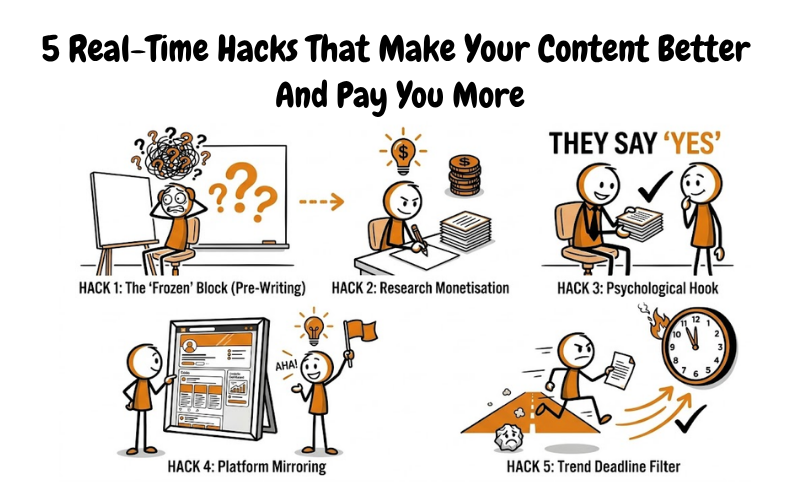
These five hacks come directly from the questions we’ve been building on across this series. If you’ve been following along, you’ll recognise where each one comes from. If this is your first post — welcome. These will still work.
Let’s go through them one by one.
Hack 1: Stop Doing Research for Free
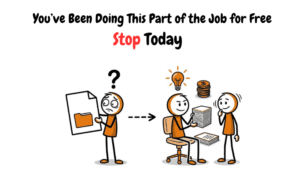
This one feels uncomfortable the first time you do it. Do it anyway.
When a client gives you a topic but no audience information — no details about who they’re writing for, what those people are afraid of, what they want — most beginner writers just figure it out themselves and get on with the writing.
I did this for months. I thought it was part of the job.
It isn’t. Research is a service. And it should be priced as one.
Here’s what I do now. When a client sends a topic without audience data, I respond with something like: “I’ll need to do some audience research before I start — understanding their fears, frustrations, and what they’re looking for. I can include this in the project for an additional fee.”
Most clients say yes. Because they know the research makes the content better.
And the ones who push back? That’s useful information too.
The research you do — reading reviews, finding where the audience talks online, mapping their language — directly improves the quality of what you write. You’re not charging more for less. You’re charging appropriately for more.
✏️ Try this now: On your next project, before you open a blank document, spend 20 minutes finding 10 real things your target audience has said online. Reviews, forum posts, comments, anything. Write them down. Then use that language in your opening paragraph. Send the client the first draft and watch the response change.
Hack 2: Write the Reader’s Inner Voice Before You Write Anything Else
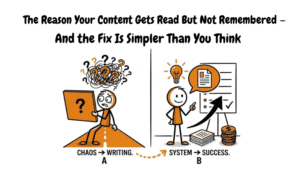
Most content gets forgotten within an hour of being read.
Not because it was badly written. Because it didn’t feel like it was for anyone specific.
Before I write a single sentence of any piece now, I do one thing. I write out — in a few lines — what my reader is feeling right now. Not what the article is about. What the person reading it is carrying.
Their fear. Their frustration. The thing they’ve tried that didn’t work. The result they want and the doubt that’s sitting between them and it.
It sounds like this: “She’s 26, been freelancing for four months, has had three unpaid trial projects, is starting to wonder if she’s cut out for this, and would feel genuinely relieved if someone just told her clearly what to do next.”
Now I write to that person.
Not to a demographic. Not to a niche. To her.
When you write with that level of specificity in mind, the reader feels something shift. They feel understood. And content that makes someone feel understood doesn’t get forgotten.
✏️ Try this now: Before your next piece, write 4 sentences describing your reader’s current emotional state. What are they afraid of? What have they tried? What are they hoping this article will give them? Don’t use this in the article — just keep it open in a separate tab while you write. Read it every time you feel the writing getting vague.
Hack 3: Mirror the Platform Before You Write for It
This one has saved me from embarrassing rejections more than once.
When you’re writing a guest post, or content for a specific website that isn’t yours, the biggest mistake you can make is writing in your own voice without checking if it fits.
Editors don’t just want good writing. They want good writing that sounds like it belongs on their platform.
Two completely different things.
Before I write for any new platform now, I spend 20 minutes reading their existing content. Not to copy the style — to understand it. How long are the paragraphs? Do they use subheadings or flow without them? Is the tone warm and conversational or precise and authoritative? Do they use the second person? Do they use examples?
I write down what I notice. And then I write the piece with those notes open.
The result is content that feels native to the platform. The editor reads it and thinks “this writer gets us.” That’s how you go from a one-time guest post to a regular contributor.
It also applies when writing for clients. Read their existing content before you write a single word for them.
Nothing loses a client faster than a piece that sounds like a completely different brand.
✏️ Try this now: Find any blog or publication you’d love to write for. Read three of their articles. Then write down five things you notice about their style — sentence length, tone, how they open, how they close, whether they use ‘you’ a lot. Now write your first 200 words for that platform using those five observations. Compare how different it feels from your default style.
Hack 4: Ask About the Deadline Before You Write a Single Word About a Trend
I have a piece of content sitting in my drafts that I will never publish.
I wrote it in response to something that was everywhere online for about four days.
By the time I finished, nobody was talking about it anymore.
Trend-based content has one rule above all others: publish before the moment dies. Miss that window and the content is not just less effective — it’s completely useless.
So now, the moment a client asks me to write something trend-related, the first thing I ask is: when do you need this published? Not “when would you like it” — when does it need to be live to still be relevant?
If the answer is “anytime this week” and the trend is already three days old, I say so.
Politely. Clearly. With a recommendation to either move fast or pivot to an evergreen angle on the same topic.
Clients appreciate this. It shows you understand content strategy, not just content writing. And that distinction is the difference between a writer who gets rehired and one who delivers work that never sees the light of day.
✏️ Try this now: Next time you see a brand use a trending topic in their content, write down the date. Then check back in two weeks and search for that content. Is it still being shared? Is it still relevant? Do this five times and you’ll develop a sharp instinct for how long different types of trends actually last — and when to push a client to move faster.
Hack 5: Treat Lead Generation Content Like a Paid Product
Here’s something that changes how you approach an entire category of writing.
When content is locked behind a sign-up form — where the reader has to give their name and email to access it — that reader is not getting it for free. They’re paying with their personal information. And that is a transaction they take seriously.
If the content disappoints them, they don’t just move on. They lose trust in the brand.
They feel like they were tricked into handing over their details for something that wasn’t worth it.
So whenever I’m writing a lead generation asset — a gated eBook, a downloadable guide, a locked article — I write it at the standard of something someone paid for.
Deeper research. Stronger structure. More specific, more useful, more complete.
Not just “good enough to get the click.” Good enough to make the reader glad they gave their email.
That shift in standard changes the quality of everything you produce for lead generation. And it changes how the brand’s audience feels about them after they download it.
When the content over-delivers on the promise, trust is built fast. The reader becomes a warm lead who already likes the brand. That’s worth infinitely more than a gated PDF that disappoints and loses the person forever.
✏️ Try this now: Find any free download or gated resource you’ve signed up for in the last year. Be honest with yourself: did it feel like it was worth giving your email for? What would have made it worth it? Write down three specific things that were missing or could have been deeper. That list is your standard for the next lead generation asset you write.
One Thing Connects All Five of These
None of these hacks are about writing technique.
They’re about understanding the situation you’re writing in before you write a single word.
Who is the reader and what are they carrying right now.
Why does this content exist and what should it make someone feel or do.
Where will it live and what does that platform ask of the writing.
When does it need to exist and how long will it matter.
What standard does this format demand and am I meeting it.
These are the same five questions from the previous posts — but now you can see how they translate directly into professional habits. Habits that make your writing better, your clients happier, and your work worth more.
You don’t need years of experience to do any of this.
You need the willingness to slow down before you start and ask the right questions.
That willingness — that habit of thinking before writing — is what separates a beginner who stays a beginner from one who becomes someone clients trust and return to.
If you’re just joining this series, start from the previous post — it gives the foundation that makes everything in this one land properly.
The next post moves into the actual craft of writing — how to open a piece in a way that earns the reader’s attention, how to keep them reading through the middle, and how to close in a way they actually remember.
That’s where a lot of writers struggle most. We’re going to go through it carefully.
If any of these five hacks helped you see something differently today — share it with someone who needs it. And drop your questions in the comments. I read every one.
— Hema Varman