
After I published the last post, a few people messaged me.
Not to say it helped — though some did, and that always means a lot.
They messaged to ask follow-up questions. Real ones. The kind you don’t put in a comment because they feel too basic.
Questions like: “Okay but what if the client doesn’t know their audience either — what do I do then?”
Or: “How do I know if content is evergreen or not — is there a rule?”
Or my favourite: “I understand the five questions now but I still don’t know where to actually start.”
These aren’t small questions. These are the questions that separate someone who understands content writing in theory from someone who can actually sit down and do it.
So this post is for those messages. I’m going to answer the six most common follow-up questions as honestly as I can — the way I would over a call with someone just starting out.
“What if the client doesn’t give me any audience information at all?”
This happens more than you’d think. And it’s not always laziness on the client’s part.
Sometimes they genuinely haven’t figured it out yet.
When that happens, the first thing I do is go to their website. Read the homepage carefully. Look at the products or services they offer and ask: who would need this and why?
Then I go looking for where their customers are already talking.
Review sections on Amazon. Comment threads on their social posts. Quora questions in their niche. Reddit threads.
Real customers say things like “I was so frustrated because…” and “I’ve tried everything and nothing worked until…” That language is gold.
Use it. Not to copy — to understand. When you write back to people using the same words they used to describe their own problem, they feel like you’re reading their mind.
And if the client wants you to do this research, charge for it.
This is skilled work. It takes time. It makes the content significantly better. It is not free.
✏️ Try this now: Find any brand whose customer reviews you can read — on Amazon, Google, or their social pages. Spend 20 minutes reading the negative reviews specifically. Write down the exact phrases people use to describe their frustration. Now look at that brand’s website copy. Do they use that language? Most don’t. That gap is your opportunity as a writer.
How do I figure out the intention if nobody tells me what it should be?
I used to wait for the brief to tell me this.
Most briefs don’t. They give you a topic and a word count and call it a day.
So I started asking one question that changed everything: where does this content sit in the customer’s journey?
Is the reader discovering this brand for the first time? Then the content’s job is to make them feel understood and curious — not to sell.
Are they already interested but unsure? Then the content’s job is to answer their doubts and build trust.
Are they close to buying? Then the content’s job is to remove the last objection standing between them and the decision.
Different stages. Different intentions. Completely different writing.
When you understand where your reader is in their journey, you stop writing generic content and start writing content that actually moves someone forward.
✏️ Try this now: Think about the last time you bought something online after reading about it. Walk yourself backwards through the journey — what did you read first? What made you trust the brand? What finally made you decide? Map that out on paper. You’ll see the three stages clearly. Now apply that map to the next piece you write for a client.
“Does the platform really change that much? Can’t I just write well and it’ll work anywhere?”
I understand why this feels true. Good writing is good writing, right?
Not quite.
A beautifully written 1,500-word blog post dropped into an email will get deleted. The same information as a LinkedIn post written in short punchy sentences could get thousands of views.
It’s not that the writing was worse. It’s that the format didn’t match the platform. And readers feel that mismatch immediately, even if they can’t name it.
Think about how you read on different platforms.
On Instagram you scan. On a blog you settle in. On LinkedIn you skim until something stops you. In an email you decide in the first two lines whether to keep reading.
Each platform has trained its users to read in a specific way. Your job as a writer is to meet them in that mode — not drag them into yours.
This is actually one of the most valuable things you can offer as a writer.
Most people can write. Far fewer can write the same idea in five different ways for five different platforms without it feeling forced.
✏️ Try this now: Pick one insight or idea you genuinely believe — something from your own experience. Write it four ways: a 3-sentence Instagram caption, a 5-line LinkedIn post, the opening paragraph of a blog post, and the first two lines of an email subject + preview. Read them all back. Notice how the same truth sounds completely different depending on where it lives.
How do I know if something is evergreen or trend-based?
Honestly? Ask one question.
Will someone searching for this in two years still find it relevant?
If yes — it’s evergreen. Write it with depth and care. Invest time in the research. It will keep working for you long after you publish it.
If no — it’s trend-based. Move fast. Publish before the moment passes. Depth matters less than timing.
“How to write a blog post” — evergreen. Someone will search that today, tomorrow, and three years from now.
“Brands reacting to the Suez Canal blockage” — trend. Miss the 48-hour window and the content is already dead.
Most content falls clearly into one category once you ask the question.
The tricky ones are topics that feel current but have lasting value — like a post about AI tools for writers. That might need updating every six months, but the core of it stays relevant.
Those “evergreen with updates” pieces are actually some of the most valuable content you can write, because they keep ranking and keep getting traffic — you just refresh them occasionally.
✏️ Try this now: Go to your own search history from the last week. Pick five things you searched. Ask honestly: would I still search this in two years? You’ll start to feel the difference between evergreen and trend content in a way no explanation can give you. Now apply that instinct to your next content project.
What are the hardcore rules for different formats? Where do I learn them?
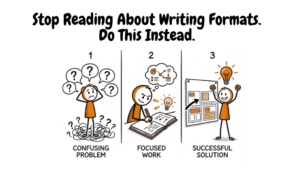
Every format has non-negotiables. Things that must be there for the content to do its job.
A press release without a date, location, and clear newsworthiness angle isn’t a press release — it’s a business update that no journalist will touch.
A sales page without social proof is just a brand talking about itself. Readers don’t trust brands talking about themselves. They trust other people’s experiences.
A product description that only lists features — without a single benefit — is just a spec sheet. It answers “what is it” but not “why should I care.”
The best way to learn the rules of any format is not to read about them.
It’s to find the best examples of that format in the wild and reverse-engineer them.
Find a press release from Apple. Find a sales page from a product you actually bought. Find a white paper from HubSpot. Read them slowly. Map the structure. Ask why each section is there.
You’ll find the rules faster that way than any course will give them to you.
And because you found them yourself, they’ll actually stick.
✏️ Try this now: Pick one format you’ve never written. Find the best example you can of that format from a brand you respect. Give yourself 30 minutes. Read it once all the way through. Read it again, this time writing down every section and what job it’s doing. You now have a template. Use it for your first attempt at that format.
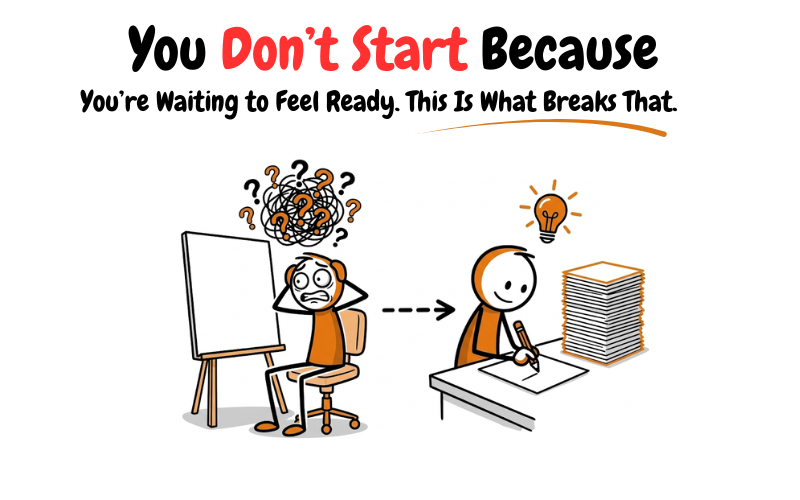
I understand all of this in theory. But I still don’t know how to actually start. What do I do first?
This is the most honest question of all.
And I think it deserves the most honest answer.
You start badly. On purpose.
The first draft of anything is not supposed to be good. It’s supposed to exist.
The biggest mistake beginners make is waiting until they feel ready to write something good.
That feeling never comes. Not before you start. It comes after — sometimes on the third draft, sometimes on the tenth, sometimes only after you’ve published and seen how readers respond.
So here’s what I actually want you to do right now.
Answer the five questions from the last post for a piece you’ve been putting off. Write them out. Then open a blank document and write the worst possible version of that piece — no editing, no second-guessing, just get the ideas out.
Once it’s out, you’ll see what you actually have. And you’ll know what it needs. You cannot edit nothing. You can always edit something.
That’s how every working writer starts. Not with confidence. With a document open and a decision to write anyway.
✏️ Try this now: Set a timer for 20 minutes. Answer the five questions for one piece of content you’ve been avoiding. Then — without closing the document — write the opening paragraph. Don’t edit it. Just write it. When the timer goes off, you have a start. That’s more than you had 20 minutes ago.
If you missed the previous post that started this conversation — go read that one first. This one builds directly on it.
The next post is going to get into the actual craft of writing — how to open a piece in a way that makes someone stay, how to structure it so they keep reading, and how to close in a way that stays with them after the tab is closed.
That’s the part most writing guides skip over. We’re not going to skip it.
If this post answered something you’ve been sitting with — share it with someone else who’s in the same place. And leave your question in the comments. I read every single one.
— Hema Varman