
The first time I sat down to write a blog post for a client, I just started writing.
I had the topic. I had the word count. I thought that was enough.
It wasn’t.
I spent three hours writing something that looked fine on the surface — decent sentences, a few headings, some tips.
The client read it and said something that has stuck with me ever since.
“This doesn’t feel like it’s for our customers. It feels like it’s for everyone.”
He was right. And I had no idea how to fix it because I had skipped the most important part of the entire writing process.
The part that happens before you open the document.
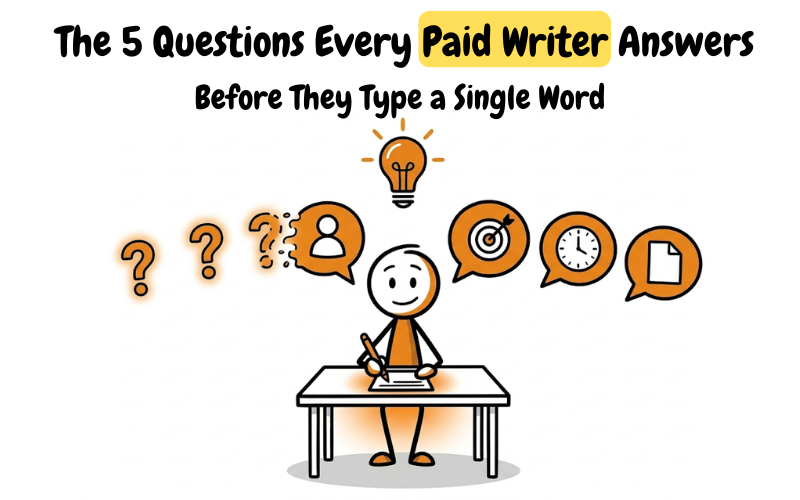
There are five questions every content writer needs to answer before writing a single word. Not after. Not halfway through. Before.
I’m going to walk you through all five. And I’m going to be honest about what happens when you skip them — because I’ve done it, and it cost me time, clients, and confidence.
1. Who Are You Actually Writing This For?
I know this sounds obvious. Stay with me.
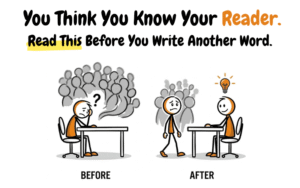
When I ask beginner writers who their audience is, most of them say something like “people interested in fitness” or “small business owners.”
That’s not an audience. That’s a population.
Your reader is not a category. They’re a person. A specific person sitting somewhere right now with a specific problem that’s keeping them stuck.
Maybe they’re a 28-year-old in Chennai who wants to lose weight but hasn’t been able to stick to a diet for more than two weeks.
Maybe they’re a freelancer who’s been writing for six months and still hasn’t landed a client and is starting to wonder if they ever will.
That level of specificity changes everything about how you write.
You need to understand their fears — the ones they don’t say out loud. Their frustrations — the things they’ve tried that haven’t worked. Their desires — not just what they want, but why they want it.
And here’s something important: if you’re writing for a client and they don’t know who their audience is, that’s a research job — and you can charge for it.
Audience research is not extra. It’s the foundation.
✏️ Try this now: Before your next piece of writing, describe your reader in 5 sentences. Give them an age, a situation, a frustration they’ve been carrying, something they’ve already tried, and the one result they want more than anything. Read those 5 sentences before you write your first word. See how differently the writing comes out.
2. Why Does This Piece of Content Need to Exist?
This is the question most people never ask. And it shows in their writing.
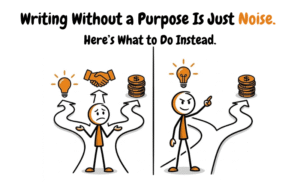
Every piece of content needs a job. Not “to share information” or “to stay consistent.” A real, specific job.
Should the reader feel inspired and take action? Should they understand something they were confused about? Should they trust the brand enough to give their email address?
Should they feel seen — like someone finally understands what they’re going through?
When you know the answer to that, your writing becomes intentional. Every sentence is doing something. Every paragraph earns its place.
When you don’t know the answer, the writing drifts. It’s pleasant but forgettable. The reader finishes and moves on without feeling anything.
And in a world where someone scrolls past hundreds of pieces of content every day, forgettable is the same as invisible.
✏️ Try this now: Write this sentence before your next piece: “After reading this, my reader will feel ___ and do ___.” Fill in both blanks. If you can’t fill them in, you’re not ready to start writing yet. This one sentence will keep your entire piece on track from the first line to the last.
3. Where Will This Content Actually Live?
The platform is not just a technicality. It completely changes how you write.
A blog post and a LinkedIn article on the same topic should feel completely different. One is a long, quiet read someone chose to sit with. The other is competing with a hundred other things in a busy feed.
A guest post on someone else’s website needs to match their tone, their reader, their style — not just yours.
A press release follows rules you can’t break. A lead generation article needs to earn the reader’s email address, which means the hook and the promise have to be strong enough to make them want to give it.
I learned this the hard way too. I once wrote a guest post in my own casual style and the editor came back saying it didn’t fit their publication. I had to rewrite it almost completely.
Know the platform before you start. It tells you the personality, the length, the tone, the structure — everything.
✏️ Try this now: Take one topic you know well. Write the opening paragraph three different ways — once for a blog, once for a LinkedIn post, once as the opening of an email. Read all three out loud. You’ll immediately feel how different they need to be. That instinct is what clients pay for.
4. When Will It Be Published — And Does It Have an Expiry Date?
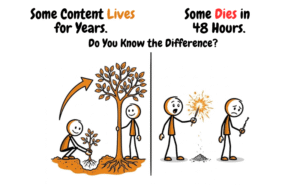
Some content is meant to last for years. Some has a 48-hour window.
Writing the wrong kind for the wrong moment is a silent mistake that kills a lot of good work.
Evergreen content — blog articles, guides, eBooks — is designed to keep working long after you wrote it. Someone might find your blog post two years from now and it’ll still be relevant. That kind of content deserves depth and careful research.
But trend-based content is completely different. Remember when a ship got stuck in the Suez Canal and every brand found a way to make a meme out of it?
That content had a two-day lifespan. Miss the window and nobody cares anymore.
Knowing the lifespan before you start tells you how much time to invest, how urgent the deadline is, and how deep to go.
It also saves you from spending three days writing a beautifully crafted piece about something that will be irrelevant by Tuesday.
✏️ Try this now: Think of the last piece of content you wrote or plan to write. Ask yourself honestly: is this evergreen or trend-based? If it’s evergreen, are you going deep enough? If it’s trend-based, have you already missed the moment? This one question will save you from wasted effort more times than you can imagine.
5. What Format Does This Content Need?
Format is not just about length or structure. It’s a decision about how this content will serve its reader.
A white paper without data and research feels thin and unconvincing. A blog post written in formal, corporate language feels cold and unreadable. An email that reads like a press release gets deleted without a second thought.
Each format has its own rules. Its own essential elements. Its own tone.
And there are things that simply must be there for the content to do its job properly.
A sales page without testimonials is just claims. A product description that lists features without benefits is just a spec sheet. An eBook without a clear promise in the introduction is just a long document nobody finishes.
When you know the format before you start, the decisions almost make themselves.
You know what to include. You know what to cut. You know how to open and how to close.
When you don’t know the format, you spend half your time second-guessing yourself in the middle of the piece. And readers feel that uncertainty — even if they can’t name it.
✏️ Try this now: Pick one format you’ve never written before — press release, white paper, video script, email sequence, anything. Find one real example of it from a brand you trust. Don’t just read it — map it. Write down what comes first, second, third. What’s always there? What’s never there? You now have a working template that no course gave you.
Here’s What Happens When You Ask All Five Questions First
Something shifts.
The blank page stops being scary. Because you’re not staring at nothing anymore — you’re sitting with a clear picture of a real person, a real purpose, a real platform, a real deadline, and a real structure.
The research focuses itself. You know exactly what to look for because you know exactly what your reader needs to understand.
The tone becomes obvious. You know whether to be warm or authoritative, casual or precise, because you know where it’s going and who it’s for.
And the reader feels the difference. They might not be able to explain why your writing feels different from everything else they read that day.
But they feel it. And they keep reading.
That feeling — of being understood before you even asked — is what the best content creates. And it starts not when you open the document, but in the five questions you ask before you do.
If any of this resonated — go back and read the previous post on content formats with these five questions in mind. You’ll see every format differently.
The next post gets into the actual writing — how to open a piece in a way that makes someone stay, how to keep them moving through it, and how to close in a way that stays with them after they’ve left the page.
That’s coming next. And if you have a question about anything we covered here — drop it in the comments. I genuinely read every one.
— Hema Varman