

You sit down to write.
You open a blank document.
You type a few sentences.
And then you stop.
Something feels off. The words are there but it feels like you are talking to nobody in particular. Like shouting into an empty room.
I have been there. And I know exactly why it happens.
You are writing without knowing who you are writing for.
This is the mistake that most beginner content writers make. Not grammar. Not structure. Not even vocabulary.
They write for “everyone.”
And content written for everyone connects with no one.
In this post, I am going to walk you through two concepts that will completely change how you approach writing — niche and audience research. These are not theory. These are the practical foundation that every working content writer builds their career on.
By the end of this guide, you will know:
- What a niche is and how to find yours
- Why being a specialist always pays more than being a generalist
- How to understand your audience so well that your content speaks directly to them
- A simple research trick using Amazon that works for any industry
Let’s get started.
What Is a Niche? (And Why You Cannot Write for “Everyone”)
Let me give you the simplest definition first.
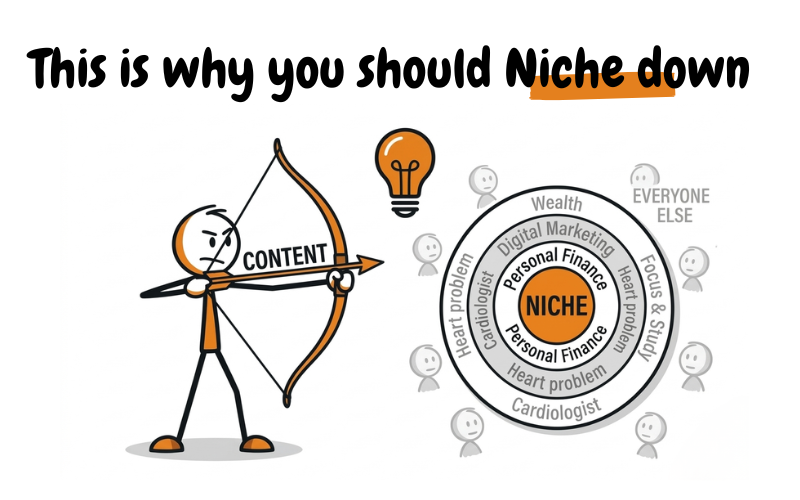
A niche is a small, specific segment of a bigger market.
That’s it.
The internet is massive. Millions of topics. Millions of industries. Millions of readers. No single writer — and no single website — can cover everything well.
Think about the Health industry for a moment.
Health is a huge market. But inside health, you have Cardiology, Gastrology, Neurology, Fitness, Nutrition, Mental Health, and hundreds of other segments. Each one of those is its own world with its own audience, its own problems, and its own language.
A writer who tries to cover all of health will never become an expert in any of it.
But a writer who goes deep into Strength Training or Gut Health or Mental Wellness? That writer becomes the go-to person for that specific audience. And that is where the real opportunities are.
Here is how a niche is formed — going from broad to specific:
Wealth → Online Business → Digital Marketing → Affiliate Marketing
Health → Physical Fitness → Exercise → Strength Training
See how you keep drilling down until you reach something specific? That specific thing at the end — that is your niche.
💡 Quick Tip: The three most profitable niches on the internet are Health, Wealth, and Relationships. Almost every successful blog, course, or online business falls under one of these three categories.
Why Being a Specialist Always Pays More Than Being a Generalist
Let me ask you something.
If you had a serious heart problem, would you go to a general physician or a cardiologist?
The cardiologist. Every time.
And who charges more? The cardiologist. Who does the patient trust more? Still the cardiologist.
The same logic applies directly to content writing.
A writer who specialises in SaaS content will always earn more than a writer who “writes about anything.” A writer who understands the fitness industry inside out will always be more valuable to a fitness brand than someone who writes across five different industries.
Being a specialist means two things:
- You develop deep knowledge over time.
The more you write in one niche, the more you understand it. You learn the terminology. You know the common questions. You understand what the audience is afraid of and what they want. That depth shows in your writing — and clients notice it.
- Clients start to see you as a trusted expert, not just another writer.
When a brand in personal finance is looking for a writer, they will always prefer someone who has been writing about personal finance for two years over a generalist with no clear focus.
You do not need to be an expert on day one. Pick something that interests you and write consistently within it. The expertise builds as you go.
💡 Quick Tip: When you are writing for a client, always ask them: what is your specific niche? What products or services do you offer? Without this answer, your content will be too broad to be useful — and too generic to convert.
What Is Audience Research and Why It Matters More Than You Think
Once you know your niche, the next question is this:
Who exactly are you writing for?
Your audience is the group of people inside your niche who have a specific problem and are actively searching for a solution online.
Here is where most beginners go wrong — they define their audience too broadly.
For example, if you are writing content for a smartphone brand, your audience is not “everyone who uses a phone.” That is almost the entire planet. That is useless.
Your actual audience might look like this:
“College students in India, aged 18–24, looking for the best smartphone under ₹15,000 for photography and gaming.”
Now that is specific. That is someone you can write for. You know their budget. You know their priorities. You know exactly what questions they have before buying.
Here are the five things you need to research about your audience before writing a single word:
- Pain Points — What problem are they struggling with right now?
- Fears — What are they afraid of getting wrong?
- Desires — What result do they desperately want?
- Questions — What are they actively searching for online?
- Language — What exact words and phrases do they use when describing their problem?
That last point — language — is the most underrated thing in all of content writing. When you use the same words your audience uses, your content immediately feels like it was written just for them.
💡 Quick Tip: A good audience profile looks like this — “Males in India, aged 25–40, who want to get fit without going to the gym, only through diet and nutrition.” The more specific your profile, the more your content resonates.
What Happens When You Actually Understand Your Audience
This is the part most beginners skip over entirely — the why behind niche and audience research.
When you write content that speaks directly to a specific person’s situation, five things happen:
- They trust you faster.
When someone reads your content and thinks “this person understands exactly what I am going through” — trust is built immediately. People buy from those they trust. People follow those they trust. People recommend those they trust.
- You help them make decisions.
Think about the last time you read a review article before buying something online. It answered your exact questions, cleared your doubts, and made the decision easier. That is what audience-focused content does. It removes friction between the reader and the decision.
- You create an emotional connection.
When you use the same language your audience uses to describe their own problems, something clicks. They think — this person gets me. That emotional connection is very hard for a competitor to copy.
- Your brand stays in their head.
Consistently relevant content keeps you top of mind. When your audience is ready to buy, they remember you — not your competitor who wrote generic articles for nobody in particular.
- Clients keep hiring you.
If your content brings real results — more traffic, more trust, more sales — your client will keep coming back. Audience research is what produces those results. It is what separates writers who get repeat work from writers who are always chasing the next project.
The Amazon Strategy: How to Understand Any Audience in Under 30 Minutes
This is my favourite practical research method. And the best part? You can use it even if you know absolutely nothing about the industry.
I call it the Amazon Strategy.
Here is exactly how it works, step by step.
Step 1: Go to Amazon and search for a product in your niche.
Let’s say your niche is Strength Training. Search for “Dumbbells” on Amazon India.
Step 2: Read the customer reviews — especially the 1-star and 2-star ones.
Skip the 5-star reviews for now. Go straight to the negative ones. This is where your audience tells you — in their own words — exactly what frustrated them, what they were afraid of, and what they desperately wanted but did not get.
For example, real reviews on dumbbells said things like:
- “Cheating seller — the 5kg weight was actually only 3kg”
- “Product arrived completely broken”
- “The material is horrible and cheap”
- “Filled with stones instead of actual weight”
Step 3: Turn those pain points directly into your content.
Instead of writing a generic product description like “High quality dumbbells for your home gym” — you now write:
“We don’t disappoint you like other cheating sellers. Our dumbbells weigh exactly what is printed on them — guaranteed.”
“Built to last. Not filled with stones. Not made of cheap material. Just solid, reliable dumbbells that work.”
See the difference?
You took the exact words from real customer complaints and flipped them into your content. Words like “cheating sellers,” “broken,” “filled with stones.” These are phrases your audience already uses. When they read your content and see those same words, they immediately feel like you understand them.
That feeling of being understood is what builds trust. And trust is what builds a business online.
💡 Quick Tip: This Amazon strategy works for any niche — fitness, finance, parenting, tech, cooking, anything. Every product category on Amazon has reviews full of pain points, frustrations, and desires. That is your free audience research. Use it.
Quick Summary: What You Learned in This Post
Before you go, here is a quick recap of everything we covered:
- A niche is a specific, focused segment of a bigger market
- The three most profitable niches are Health, Wealth, and Relationships
- Specialists always earn more and are trusted more than generalists
- Your audience is the specific group of people with a specific problem inside your niche
- Research their pain points, fears, desires, questions, and language before writing
- Use the Amazon Strategy to find your audience’s exact language fast
- Understanding your audience builds trust, drives decisions, and keeps clients hiring you
If you have not read my previous post on the difference between content writing and copywriting yet — I recommend you go through that first. This series is designed to build on itself, and that post gives you the foundation you need before applying what we covered here.
The next post in this series is going to cover something very practical — the different formats of content that are in demand right now and which ones you should focus on as a beginner.
Stay tuned.
If you found this post helpful, do share it with someone who is just starting out in content writing. And if you have any questions — drop them in the comments below. I read every single comment.
— Hema Varman