

Let me ask you something.
When you first heard about content writing as a career, did you immediately think — “But wait, what about copywriting? Isn’t that the one that actually pays?”
If yes, you are not alone.
I thought the same thing. And honestly? That thinking cost me a lot of time.
When I started out, I kept seeing people talk about copywriting like it was the golden ticket. “Write one sales email and earn ₹50,000.” “One landing page and you’re set for the month.” So I tried to jump straight to copywriting — without learning the basics of content writing first.
The result? Everything I wrote felt hollow. Forced. Nothing converted. Nothing clicked.
It took me way too long to figure out why.
In this post, I want to save you from making that same mistake. I’ll break down exactly what content writing and copywriting are, what makes them different, and most importantly — which one you should focus on first (and why).
Let’s get into it.
Content Writing vs Copywriting: The One-Line Difference
Before I dive deep, let me give you the simplest version of this:
Content writing = creating content to inform, educate, or build trust.
Copywriting = writing to persuade someone to take action right now.
Same skill at the core. Completely different purpose.
Think of it this way. When you read a helpful blog post that answers a question you had — that’s content writing. When you read a sales page that makes you want to pull out your wallet immediately — that’s copywriting.
Both are written words. But one is building a relationship. The other is closing a deal.
What Is Content Writing? (And Where You’ll Find It)
Content writing is the art of creating content that serves the reader first.
The goal is not to immediately sell something. The goal is to inform, educate, entertain, inspire, motivate, or nurture the reader over time.
You will find content writing everywhere on the internet:
- Blogs and articles — like the one you’re reading right now
- SEO-optimised web pages — content written specifically to rank on Google
- Product descriptions — those short write-ups on Amazon or Flipkart before you buy
- eBooks and guides — downloadable content that builds authority
- Newsletters — regular emails that keep an audience engaged
- Social media posts — captions, LinkedIn posts, Twitter threads
- Reviews and comparisons — content that helps people make buying decisions
- Press releases and white papers — informational content used in business
Notice something? All of these are designed to give the reader something valuable. The trust builds slowly. The sale, if it comes, comes later — after the reader already trusts you.
Pro Tip: Most successful blogs in India — including the biggest ones — are built entirely on content writing. Revenue comes from ads, affiliate marketing, and services. But the foundation? Always content.
What Is Copywriting? (And Where You’ll Find It)
Copywriting is the art of persuading someone to take a specific action through written words.
The keyword here is action. A copywriter wants the reader to do something specific — and do it now. This specific action is called a Call to Action (CTA).
Some common CTAs you’ve definitely seen:
- “Click here to download”
- “Buy now and get 50% off”
- “Sign up for free”
- “Book a call today”
You will find copywriting in:
- Facebook and Instagram ads — every ad you scroll past was written by a copywriter
- Lead generation pages — pages designed to collect your name and email in exchange for something free
- Written Sales Letters (WSL) — long pages where every element is designed to sell one product
- Video Sales Letters (VSL) — scripted videos where every word pushes you toward a purchase
- Marketing emails — the kind with a strong subject line and a clear CTA
Pro Tip: Every email you’ve received from a brand that made you click something? Someone wrote that very carefully. The subject line, the opening, the CTA — all of it was copywriting.
The 5 Key Differences Between Content Writing and Copywriting
Now that you know what each one is, let me break down exactly where they differ.
- The Goal
A content writer informs. A copywriter sells. When you write a blog post teaching someone how to start a blog, you’re a content writer. When you write the sales page that convinces them to buy a hosting plan, you’re a copywriter.
- The Emotion
Content writing builds a slow, steady emotional connection — like a friend who always gives you good advice. Copywriting creates urgency and emotional intensity. It makes you feel like you need to act right now.
- The Timing
Content writing plays the long game. A blog post you write today can bring readers to your site two or three years from now — for free. Copywriting is designed for immediate results. A Facebook ad that doesn’t convert this week is a failed ad.
- The SEO Focus
Content writing is deeply connected to SEO (Search Engine Optimisation). You write content that people are already searching for on Google. Done well, this brings free, consistent traffic for years. Copywriting doesn’t rely on SEO — it uses paid traffic, email lists, or social audiences.
- The Strategy
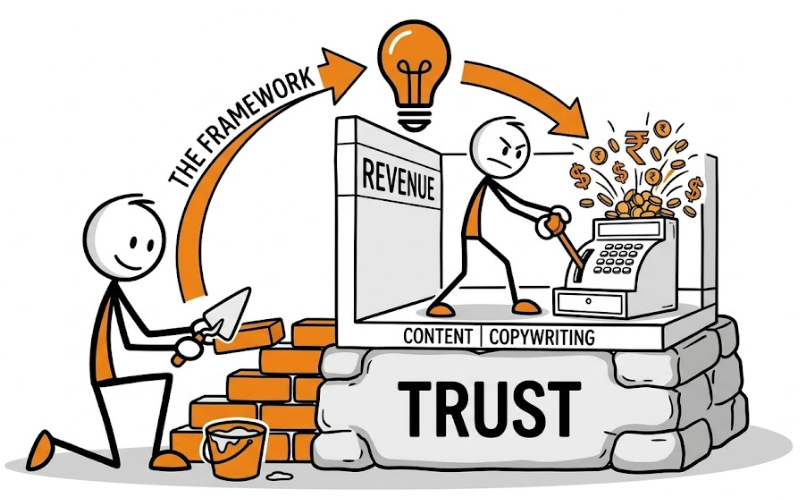
Content writing is your foundation. It builds your audience, your credibility, and your trust over time. Copywriting converts that foundation into revenue. You need both — but in the right order.
So Which One Should You Learn First?
This is the question I get asked the most. And my answer is always the same:
Learn content writing first. Every single time.
I know copywriting sounds more exciting. I know the income potential sounds bigger. But here’s what most people skip over:
The best copywriters in the world are great at copywriting because they spent years writing content first.
Writing content teaches you how to research a topic properly. It teaches you how to understand what your reader actually wants. It teaches you how to build trust through words. It teaches you how to explain things simply without losing the reader halfway through.
Those are not “nice to have” skills for a copywriter. They are the foundation of everything.
When I tried to jump straight to copywriting, I failed — not because I didn’t know the formulas, but because I didn’t understand people well enough. I didn’t know how to write for someone else’s mind.
Content writing teaches you that. Slowly, post by post — you start to understand how readers think, what they fear, what they want, and what finally makes them say yes.
By the time you move to copywriting, you won’t be guessing anymore. You’ll know.
Pro Tip: Think of content writing and copywriting as two floors of the same building. You cannot reach the second floor without climbing the first. And once you do, everything you learned on the first floor makes you 10x more effective.
A Quick Recap Before You Go
Let me summarise the key points for you:
- Content writing = inform, educate, entertain, build trust over time
- Copywriting = persuade and convert — right now
- Content writing formats: blogs, SEO articles, newsletters, product descriptions, social posts, eBooks
- Copywriting formats: ads, sales pages, lead gen pages, marketing emails, VSLs
- 5 key differences: Goal, Emotion, Timing, SEO Focus, Strategy
- Always learn content writing first — it is the foundation that makes copywriting possible
If you haven’t read my previous post yet — where I talk about how the internet runs on words and why you already have what it takes to start — I recommend you go through that first. It gives you the mindset foundation that everything else in this series builds on.
Have a question about the difference between content writing and copywriting? Drop it in the comments below. I read and reply to every single one.
Hemavarman