

TL;DR — THE SHORT ANSWER
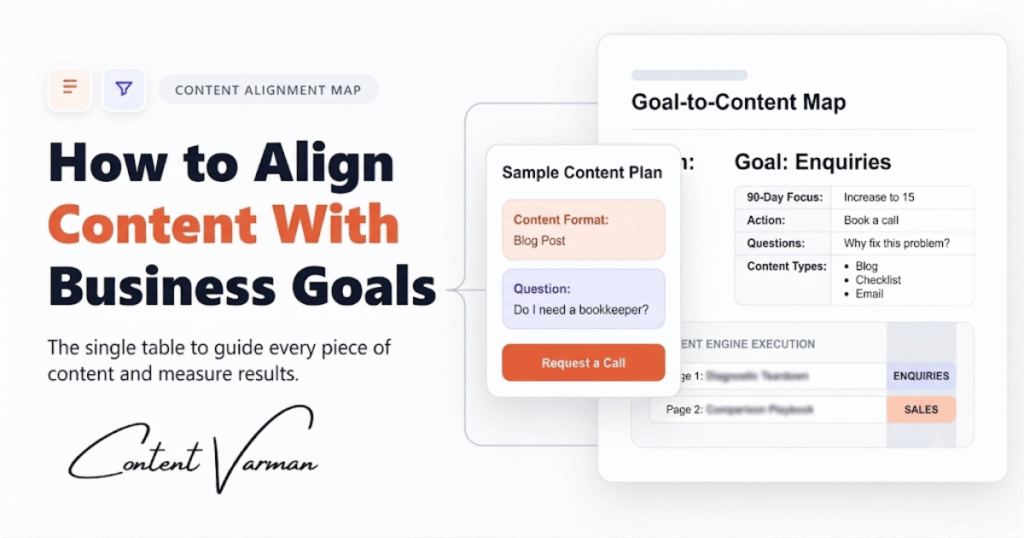
Content should support a business goal, not just fill a publishing calendar. Choose one priority (enquiries, sales or retention). Set a measurable 90-day target and decide the one action you want readers to take. Then create content that answers the questions people ask before taking that action. Put those decisions in one table. That table is your goal-to-content map, and you can use it to check every new idea.
Most teams are not short of content ideas. The real problem is that their posts are not tied to a specific business result.
Posts go out every week, and some get likes or comments. But when someone asks, “How many enquiries did the blog bring in this month?”, nobody knows. This often happens because the team never defined the job the blog should do.
This guide shows you how to align content with business goals. You’ll finish with a one-page map that links each goal to the content that supports it.
What you need
- A doc or spreadsheet
- Your last 10–20 posts (for the review at the end)
- A rough idea of how customers reach you now (form, phone, WhatsApp, email, referrals)
- Any analytics you already have. If you have none, a simple enquiry log works for now.
Six steps to your goal-to-content map
1. Choose one business goal
Content marketing goals fall into three groups for most small and mid-sized businesses. Choose one as your main focus for the next 90 days.
| Business goal | What you want the reader to do | Number to track |
|---|---|---|
| Enquiries | Contact you, book a call, or request a quote | Enquiries from content per month |
| Sales | Choose you over other options and buy | Deals or orders that began with content |
| Retention | Renew, buy again, or refer another customer | Renewals, repeat orders, or referrals |
You may have several priorities, but this map works best when you focus on one. A post that tries to bring in leads, close sales and keep old customers happy usually does none of them well.
How to choose: Ask which part of the business is weakest right now. If you get too few calls or form submissions, focus on enquiries. If enquiries come in but don’t turn into sales, focus on sales. If customers leave after the first purchase, focus on retention.
2. Write the goal as a sentence with a number
“Get more leads” is too vague to plan around. Use this format:
“Over the next 90 days, our content should bring in [number] of [enquiries / sales / renewals], by getting readers to [one specific action].”
Example:
“Over the next 90 days, our content should bring in 15 enquiries, by getting readers to book a free 15-minute call.”
If you don’t know what a realistic number is, start with your current monthly figure and add a modest increase. You can adjust after the first month.
3. Decide the one action each piece should lead to
This is the step most teams skip. Every piece of content should give the reader a relevant next step, and that step should match your goal.
- Enquiries: book a call, fill in a short form, or send a message
- Sales: view pricing, compare options, or request a proposal
- Retention: read a setup guide, join a customer email list, or refer someone
A post that ends with “Follow us for more” isn’t connected to anything. A post that ends with “Want us to look at your current setup? Book a free 15-minute call” is.
Choose one primary action per piece. This makes the next step clearer for the reader and makes results easier to track. A small secondary link is fine.
4. List the questions people ask before that action
Now work backwards. What does someone need to know before they would take the action from step 3?
Open a doc and write down questions from these places:
- Your sales calls and emails (what do people ask before they enquire?)
- Objections that stall a sale (“Why is it priced like this?”, “How is this different?”)
- Support messages from existing customers
Group the questions by goal:
- Enquiries: people who have a problem but haven’t chosen a solution
- Sales: people who are comparing you with others
- Retention: people who have already bought
Use the language customers use. If they say “why is my invoice wrong?”, don’t title the post “Invoice Discrepancy Resolution.”
5. Match each question to a content format
Once you have the questions, pick the format that answers each one best.
- Problem questions: short articles, checklists, simple how-to guides
- Comparison and price questions: comparison posts, pricing explainers, FAQ pages
- Trust questions: case studies, client stories, a “how we work” page
- Existing-customer questions: setup guides, customer tip emails, short walkthrough videos
You don’t need every format. Pick one or two per goal that you can keep producing.
6. Build the goal-to-content map
Put everything in one table. Use it as a quick filter for deciding which ideas deserve to be produced.
| Business goal | 90-day target | Reader’s next action | Questions to answer | Content formats | Distribution channels |
|---|---|---|---|---|---|
| Enquiries | 15 enquiries | Book a free call | “Is this problem worth fixing?” “What is it costing me?” | Articles, checklists | Blog, LinkedIn, email |
| Sales | 4 new clients | Request a proposal | “How are you different?” “Why does it cost this much?” | Comparison posts, case studies | Website, sales follow-up emails |
| Retention | 90% renewal rate | Read the setup guide | “How can I get more value from this?” | Guides, customer tip emails | Customer email list |
Screenshot suggestion: your finished table in a spreadsheet, with the goal column highlighted.
Before you approve a new idea, check it against the table:
- Which goal does it support?
- What question does it answer?
- What action follows?
If you can’t answer all three quickly, don’t publish it yet.
Example: a small bookkeeping firm
The firm publishes tax tips every week, but new clients mostly come from referrals. Here is how they filled in the map.
Goal: 10 enquiries per month.
Reader’s action: book a free 15-minute call.
Questions collected from past calls: “Do I need a bookkeeper or just software?” · “What does bookkeeping cost for a small business?” · “What happens if my records are a mess?”
Content they planned:
- “Bookkeeper or accounting software: which does your business need?” (comparison post, ends with a call-booking link)
- “What small business bookkeeping costs, and what changes the price” (pricing explainer)
- “How we clean up messy books: what to expect in the first month” (process page, builds trust)
Their earlier tax-tip posts weren’t poor content. They just didn’t answer the questions prospects ask before hiring a bookkeeper. The new posts do.
Keeping the map useful
- Update your best existing posts first. Adding a clear call to action to them is faster than writing new ones.
- Ask new customers how they found you. One short question on the enquiry form or first call gives you more useful context than assumptions.
- Review performance page by page. If your analytics tool can count clicks on your contact button or form submissions, set that up for each page. The steps differ by tool, so check its help documentation.
- Review monthly. See which posts led to actions, then create more content around similar questions, formats and calls to action.
- Some content works indirectly. A guide for current customers won’t bring new leads. That’s fine, as long as it maps to retention.
Mistakes that quietly wreck this
- Choosing too many goals. If your map has six goals, it’s a list of ambitions, not a workable plan.
- Writing for search traffic alone. Traffic only helps the business when visitors can see a relevant next step and choose to take it.
- Using vague actions. “Learn more” is weaker than “Book a 15-minute call.”
- Measuring likes only. Likes are useful feedback, but they aren’t a business result.
Troubleshooting
“I get traffic but no enquiries.”
Check whether the posts have a clear call to action and whether the topic matches what buyers ask. Informational posts may attract readers who aren’t ready to buy, so review whether the topic, audience and call to action match the people you want to reach.
“I don’t know which posts led to sales.”
Ask customers directly and log the answers. Add a “How did you hear about us?” field to your form.
“We only have time for one post a month.”
Pick the question that comes up most often on sales calls and answer it well. One post tied to a real question beats four generic ones.
“Our goal changed mid-quarter.”
Update the map and keep the old numbers for reference. Reuse the same table.
Try it now — 20 minutes
- Pick one goal and write the sentence with a number — 5 minutes
- Write the one action you want readers to take — 3 minutes
- List 5–10 real questions from sales calls or emails — 7 minutes
- Fill in the map table — 5 minutes
Then look at your last 10 posts and mark each as “supports a goal” or “doesn’t.” This quick review shows which topics need a clearer goal, a stronger call to action, or a different audience. Start with one goal, fill in one row, and check every new idea against it.