

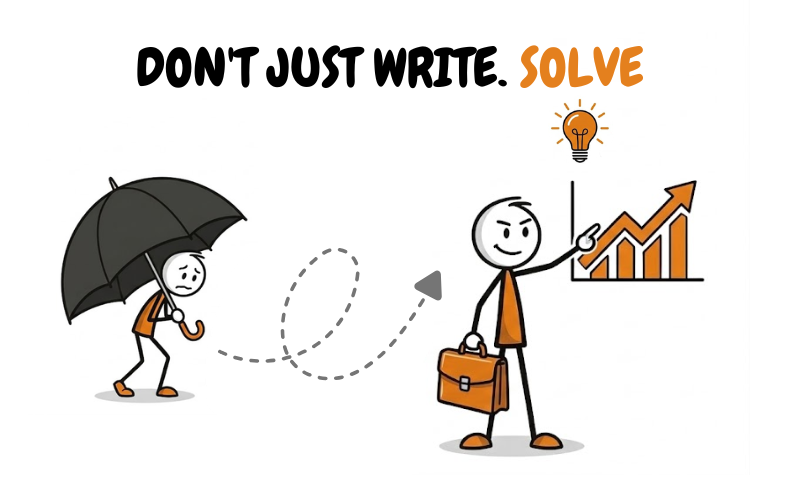
Here’s something nobody tells you when you start learning content writing.
It’s not one thing.
“Content writing” is actually an umbrella term. Underneath it, there are several different formats — each with a different purpose, a different audience, and a different reason for existing.
Some are designed to educate. Some to build trust. Some to generate leads. Some to sell directly.
And here’s why this matters to you right now.
If you want to build a career as a content writer — or use writing to grow your own business — you need to understand what each format actually does. Not just what it is. What it does.
Because a client doesn’t hire you to “write content.” They hire you to solve a specific problem. And when you understand which format solves which problem, you become far more valuable than a writer who just… writes things.
Let me walk you through the seven formats you’ll encounter most as a content writer. I’ll keep it practical. And I’ll show you, for each one, what the real job of that content actually is.
1. Blog Articles — The Slow Build of Trust
You already know what a blog is.
You’re reading one right now.
But here’s what most beginners miss about blog articles — their real purpose isn’t to “share information.” That’s a side effect. The real purpose is to build trust over time.
When a business publishes blog articles consistently, something interesting happens. Readers start to think of that business as an authority. As the go-to source. As the brand that actually understands their problem.
And that trust — built slowly, quietly, one article at a time — eventually converts into sales.
Blog articles also do something else. They attract SEO traffic — readers who find the article through a Google search. That traffic is some of the most valuable traffic on the internet, because those people were already searching for exactly what your article covers.
They came to you. You didn’t have to chase them.
That’s a powerful thing for any business. And it’s why companies invest heavily in good blog writing.
💡 Try this: Write a 400-word blog post answering one question a complete beginner in your niche would ask. Publish it — anywhere. Medium, a free WordPress site, LinkedIn. The act of writing and publishing is the practice that builds the skill.
2. eBooks — Authority You Can Hold in Your Hand (Almost)
An eBook is what happens when a blog article grows up.
It’s longer. More structured. More complete. And because of that, it carries a different kind of weight.
When someone takes the time to write an eBook on a topic — even a 20-page PDF — there’s an implicit signal to the reader: this person knows what they’re talking about. They’ve gone deep. They’ve committed.
That signal is called authority. And authority is one of the most valuable things a brand or an individual writer can build.
Businesses use eBooks in two main ways.
The first is lead generation. They offer the eBook for free, in exchange for an email address. The reader downloads it. The business now has a warm contact — someone who showed real interest in the topic. That’s a targeted lead. Far more valuable than a random visitor.
The second is direct income. Some experts sell their eBooks directly. Nutritionists. Fitness coaches. Digital marketers. The eBook becomes a product.
There’s also something elegant about eBooks as a content format — they’re cheap to produce and free to distribute. No printing costs. No shipping. No inventory. You write it once, and it can be downloaded ten thousand times without any extra effort.
💡 Try this: Take three blog posts on related topics — or three sections of notes you have on a subject you know well — and stitch them together into a simple PDF guide. Give it a title. Add an introduction. That’s an eBook. You don’t need a publisher. You need a Google Doc and an export button.
3. Press Releases — The Art of Making News
A press release is a very specific piece of writing.
It announces something. A product launch. A milestone. A new partnership. A company’s response to something that happened.
And it’s written for a specific audience — journalists and media outlets — not for regular readers.
That distinction matters. Because it completely changes how you write it.
Press releases are short. Factual. Formal. They have a fixed structure. And they’re designed to give a journalist everything they need to write a story, without any extra digging.
When a press release is picked up by a media outlet, two things happen for the brand.
First, instant credibility. Being featured in a newspaper or news website signals legitimacy. It’s third-party validation.
Second, SEO benefit. News sites that publish the press release often link back to the brand’s website. Google notices those links. Rankings improve.
It’s a format that sounds old-fashioned. It isn’t. It’s still one of the most effective ways for a brand to get visibility fast.
💡 Try this: Go to Apple’s Newsroom — apple.com/newsroom. Read two or three of their press releases. Notice the structure: the headline, the date, the location, the body, the boilerplate at the bottom. Then write a fictional press release for a product you’d love to launch one day. Follow the structure exactly. You’ll learn more from that one exercise than from any theory.
4. Product Reviews — Third-Party Trust Is a Superpower
Think about the last time you bought something online.
Did you read at least one review before purchasing?
Of course you did. Almost everyone does. Because we trust other people’s experiences more than we trust the brand’s own claims.
That’s the entire value of a product review. It comes from outside the company. And that outside perspective makes it believable in a way that advertising simply can’t be.
Professional product reviews — the kind written by content writers — are detailed, honest, and structured. They cover what the product does, what it does well, what it doesn’t, who it’s best for, and whether it’s worth the money.
And here’s the career angle that makes product reviews particularly interesting for beginner writers — affiliate marketing.
When a writer publishes a product review with an affiliate link, and a reader clicks that link and makes a purchase, the writer earns a commission. This is how many content writers create a secondary income stream — and sometimes a primary one.
The review does two jobs at once. It helps the reader make a decision. And it earns the writer money.
💡 Try this: Write an honest review of something you already own and use — your phone, your headphones, a book you loved, a skincare product. Be specific. What do you like? What frustrates you? Who would it be perfect for, and who should avoid it? Keep it to 500–600 words. Publish it on Medium. This becomes your first real writing sample.
5. Product Descriptions — Small Words, Big Impact
Every product listed on Amazon, Flipkart, Myntra, or any e-commerce site has a description.
Someone wrote all of them.
And here’s the thing about product descriptions — they look simple. A few sentences. Maybe a bullet list of features. How hard can it be?
Harder than it looks. And more important than most people realise.
Because a bad product description loses sales. A good one wins them.
The difference almost always comes down to one principle: benefits over features.
A feature is what a product is. A benefit is what it does for you.
“Contains 500mg of Vitamin C” — that’s a feature.
“Strengthens your immune system and keeps you energised through the day” — that’s a benefit.
The benefit answers the question the customer is always silently asking: “What’s in it for me?”
When you write product descriptions that lead with benefits, you’re not just describing a product. You’re showing the customer a version of their life that’s slightly better because they bought it.
That’s a very different kind of writing. And businesses will pay well for someone who understands it.
💡 Try this: Go to Amazon. Find any product in a category you know — fitness, skincare, books, kitchen tools. Read the existing description. Then rewrite it — turning every feature into a benefit. Compare the two versions. This single exercise will teach you more about persuasive writing than almost anything else.
6. White Papers — For When the Stakes Are High
White papers are a different kind of content entirely.
They’re long. Deeply researched. Data-driven. Professionally formatted.
And they’re almost always used in B2B contexts — where the decisions are bigger, the budgets are larger, and the buyers take longer to decide.
A white paper is not a sales pitch. That’s the critical distinction. It doesn’t try to sell you anything directly. It informs. It presents research, data, and expert analysis on a topic.
And that — somewhat counterintuitively — is exactly what makes it so effective.
When a company publishes a white paper that genuinely educates its target audience, that audience starts to see the company as an authority. As a thought leader. As a trustworthy source.
And when those readers eventually have a purchasing decision to make… who do they think of first?
The company that spent months educating them.
White papers are one of the most high-value content formats you can write as a professional. They’re complex. They require research. And they pay accordingly.
💡 Try this: You don’t need to write a white paper today. But you should read one. Go to HubSpot’s website and search for any of their free research reports. Download one. Read through the structure — the introduction, the data sections, the expert insights, the conclusion. Understanding the format is the first step to eventually writing it.
7. Case Studies — Real Stories That Do the Selling
A case study tells a true story.
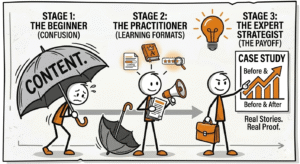
It starts with a problem — something a customer or business was struggling with. It describes what was done to address that problem. And it ends with the result — the measurable outcome.
That structure sounds simple. But the effect it has on a reader is anything but.
Here’s why.
When someone is considering buying a product or service, they have a question running quietly in the back of their mind: “Will this actually work for someone like me?”
A case study answers that question directly. With real names. Real numbers. Real outcomes.
It’s the difference between a brand saying “our service works” and a brand showing, specifically, how it worked — for a real person, in a real situation, with documented results.
That second version is so much more persuasive. Because it’s not a claim. It’s proof.
💡 Try this: Write a mini case study about yourself. Think of a time you solved a personal problem — learning a new skill, changing a habit, improving something in your life. Write it in three short sections: the situation you were in, what you did, and what changed as a result. Keep it under 300 words. That structure — situation, approach, result — is the core of every professional case study.
Where Should You Start?
If you’re new to content writing, here’s my honest suggestion.
Start with blog articles. They’re the most in-demand format. They teach you how to research, how to structure, and how to write for a reader who has a real question they need answered. Every other format on this list becomes easier once you’ve got blog writing under your belt.
Add product descriptions next. They’re short, highly practical, and everywhere. With e-commerce growing the way it is — especially in India — there’s consistent demand for writers who understand how to make a product page actually sell.
From there, let your interests and your clients guide you. A writer who understands all seven of these formats — and why each one exists — is a writer who can have a real conversation with any business about what they actually need.
And that’s a much better position to be in.
One last thing.
Understanding these formats is only part of the picture. Knowing who you’re writing for — their specific situation, their fears, their language — is what makes any of these formats actually land. If you haven’t read my previous post on niche and audience research yet, I’d suggest going back to that one first. It gives you the foundation that makes everything else work.
The next post covers the formats more closely linked to copywriting — sales pages, email sequences, landing pages. The ones designed to sell directly. Those are coming up next.
Until then — take one of the exercises above and actually do it. Writing is the only thing that makes you a better writer.
— Hema Varman