
I want to start with something that’s probably on your mind.
“If AI can write all of this — why would anyone pay me?”
It’s a fair question. And I’m not going to dismiss it.
AI can produce text faster than any human. That part is true.
But here’s what AI cannot do.
It cannot sit with the specific fear of your specific customer — at the specific moment they’re deciding whether to trust a brand or walk away.
That is what good writing actually does. It meets a real person, in a real moment, with the right words.
And that requires understanding people. Not just language.
In the previous post, we covered the content formats that build trust over time — blogs, eBooks, reviews, case studies.
This post covers the formats that are more direct. More immediate. Closer to the sale.
These are the formats where human understanding matters most.
1. Social Media Posts — The Conversation That Never Stops
Think about how you behave on Instagram or LinkedIn.
You scroll. Something stops you. You read. You feel something. You follow.
That stopping moment — that’s the job of a social media post.
It isn’t decoration. It’s a brand’s daily conversation with the people it wants to reach.
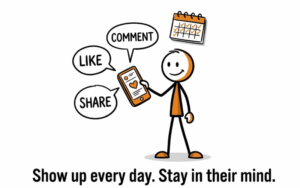
Brands post consistently for one reason above all others: top of mind awareness.
When a person is finally ready to buy something, they think of the brand they’ve been seeing every day. Not the one they saw once three months ago.
Social posts also do something else that most beginners overlook.
They replace customer service. A comment answered publicly builds trust with every person who reads it.
And here’s the career opportunity: brands like HP, Samsung, and every small business with a phone need someone to write their captions. That someone can be you.
✏️ Try this: Pick a brand you love — any brand. Write 5 social media captions for them. One for Monday, one for Wednesday, one for Friday, one educational, one emotional. Keep each under 150 words. Screenshot them. That’s your first social media writing portfolio piece.
2. Ad Copy — Where Every Word Has a Job
This is where content writing meets copywriting.
And the difference between the two becomes very clear, very fast.
An ad has one goal: make someone stop, read, and take an action.
Click. Sign up. Buy. Download. There’s always a single, specific next step.
Unlike a blog post that builds trust over months, ads give you data the same day. Views, clicks, conversions — you know what’s working almost immediately.
That speed is why businesses spend serious money on good ad writers.
But here’s what makes ad copy hard to write well.
You have three seconds. Maybe less. And you’re interrupting someone who didn’t ask to see you.
The best ad copy doesn’t feel like an ad. It feels like someone finally said the thing the reader was thinking.
Ankur Warikoo’s ads are a great example — they lead with credibility and empathy before asking for anything.
✏️ Try this: Find any Facebook or Instagram ad that made you stop scrolling. Screenshot it. Now write your own version of that ad for a different product you know well. What made the original work? What would you keep? What would you change? This analysis builds your ad writing instinct faster than any course.
3. Sales Pages — One Page. One Job. No Distractions.
A sales page has the hardest job in content writing.
It has to take a complete stranger from “I don’t know this brand” to “I’m buying this” — in a single scroll.
That’s not done with clever writing. It’s done with deep understanding.
Understanding what the reader wants. What they’re afraid of. What objection is sitting in their head right now.
A sales page answers every one of those questions — in the right order — before the reader even asks them.
That’s why great sales page writers are among the highest-paid people in the writing world.
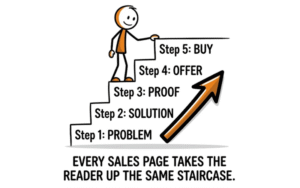
The structure of a sales page is always the same at its core: headline → problem → solution → proof → offer → action.
Social proof, testimonials, guarantees, FAQs — all there to remove doubt at every stage.
You won’t write a full sales page on day one. That’s okay.
But understanding how one works makes every other format you write sharper.
✏️ Try this: Find any online course or product you’ve actually bought. Go back to the sales page that convinced you. Read it slowly. Identify: where did they hook you? Where did they address your doubt? Where did you feel understood? Write down what you notice. You just did a sales page audit.
4. Video Scripts and VSLs — Writing What You’ll Never Read
Every video you’ve ever learned something from started as words on a page.
The voice-over. The presenter. The animated explainer. Someone wrote all of it first.
Video script writing is one of the most underestimated skills in content writing right now.
Because video is everywhere — and most brands have no idea how to script one properly.
A regular video script informs and explains. A Video Sales Letter (VSL) goes further — it follows a story arc designed to lead the viewer to a purchase by the end.
The viewer watches. They feel understood. They trust. They click.
The skill here isn’t just writing — it’s writing for the ear, not the eye.
Short sentences. Conversational language. No jargon. Every line earns the next line.
✏️ Try this: Take any YouTube video you love — something educational, under 5 minutes. Watch it once. Then write out the script from memory. Not word for word — just the structure. What did they open with? When did they give the main point? How did they end? You’ll start to see the pattern every good video script follows.
6. Email Copy — The Most Personal Format on the Internet
Every email lands in a private space. A person’s inbox.
That’s different from every other content format. It’s not a search result. It’s not a feed. It’s a direct line.
And that directness is why email is still one of the highest-converting formats in digital marketing.
An email from a brand you trust feels personal in a way an ad never can.
Email copy comes in two types. The first is newsletters — content-led emails that inform, educate, and build the relationship over time.
The second is promotional sequences — a series of emails designed to guide the reader from awareness to purchase.
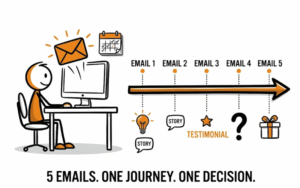
A five-email welcome sequence, for example, might introduce the brand, tell its story, share a testimonial, address a common objection, and close with an offer.
Every email in the sequence does one specific job.
Email writing rewards the writer who understands people.
Because the reader can unsubscribe in one click — and they will, the moment they stop feeling like the emails are for them.
✏️ Try this: Subscribe to the email list of a brand you admire. Read their first three emails carefully. What tone do they use? What do they share first? When do they ask for something? Write a five-email welcome sequence for a fictional brand in your niche. Use what you noticed as your guide.
The One Skill That Makes All of These Work
You’ve now seen twelve content formats across two posts.
And you might be wondering: do I really need to learn all of these?
Here’s the honest answer. No. Not all at once.
Start with two or three. Go deep. Get good. The rest follows naturally.
But there’s one skill that sits underneath every format on both lists.
And without it, nothing you write will land — regardless of the format.
That skill is understanding your reader.
Not your reader in general. Your specific reader.
What they want. What they’re afraid of. What they’ve already tried. What objection is sitting in their head right now.
AI can write a blog post. It can fill a template.
What it cannot do is feel the frustration of someone who has tried three fitness apps and failed every time — and write a product description that speaks directly to that person, in language that makes them feel understood.
That’s the gap. That’s where you live as a human writer.
And the more you understand people — not just topics — the more valuable your writing becomes.
One last thing before you go.
If you haven’t read the previous post on the 7 content formats yet — that’s Part 1 of this two-part series. Go through that first.
The next post in this series gets practical. We’re going to talk about how you actually start writing for real clients — what to write first, how to build a portfolio from nothing, and how to get your first paid project.
That’s coming up next. Stay with it.
If this helped, pass it on to someone who’s trying to figure out where to begin. And drop any questions in the comments — I read every one.
— Hema Varman